In the seasonal spirit of peace and the common interest of humanity to survive across generations…
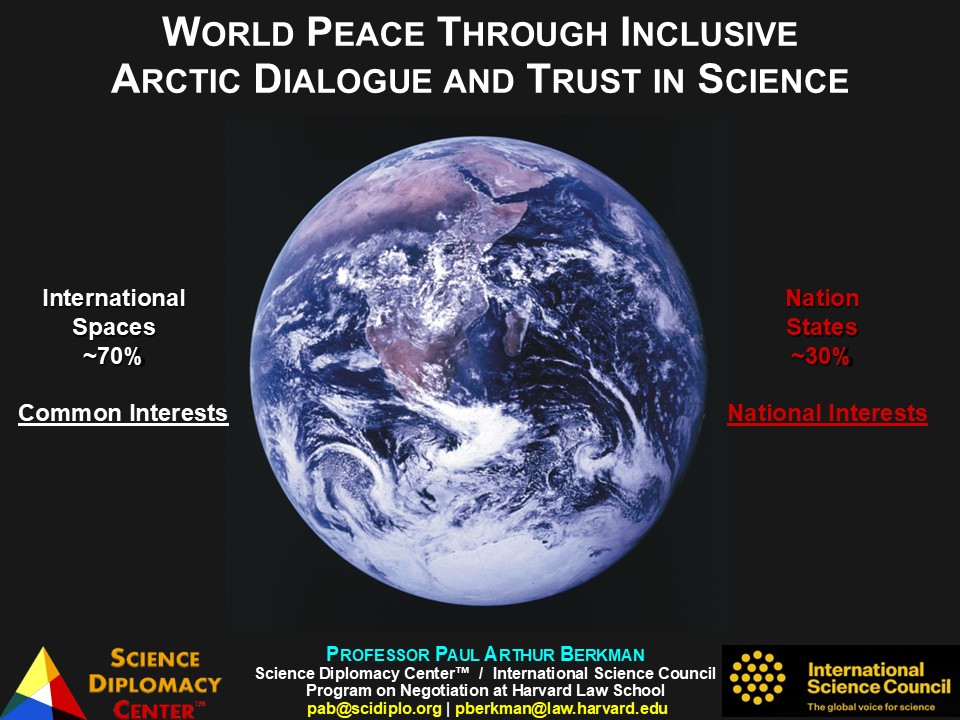
The following invited speech about “World Peace Through Inclusive Arctic Dialogue and Trust in Science” was delivered virtually in St. Petersburg, Russia, on 9 December 2025 at the Anniversary XV International Forum (ARCTIC: TODAY AND THE FUTURE) named after A.N. Chilingarov.
Thank you Interregional Public Organization “Association of Polar Explorers†(ASPOL) for your invitation to speak virtually today during the Anniversary XV International Forum “Arctic: Today And The Future†Named after Artur Nikolaevich Chilingarov.
It is an honour as well as pleasure to contribute to this session about Boundless Cooperation: International Scientific Research in the Arctic. My comments today are as a science diplomat, introducing options (without advocacy), which can be used or ignored explicitly, with respect for the diverse decisionmakers.
World Peace Through Inclusive Arctic Dialogue and Trust in Science is a path to address the most pressing issues facing humanity in view of cooperation among superpowers, in particular. The Arctic represents a convergence of interests, just as with Outer Space, underscoring the challenge we face on a global scale to balance national interests and common interests, recognizing that nations will always look after national interests first and foremost. In this calculus, the persistent difficulty is to facilitate dialogue, which is a tribute to the International Arctic Forum – Territory of Dialogue that has been ongoing since 2010, before-through-after inflection points with consistency, reflecting trust in science.
World peace is a concept that took on new meaning in the 20th century, following two world wars, and is a forever responsibility in our civilization with industrial capacities and high technologies that could enable MAD actions at any moment.  The painful truth from the 20th century is nationalism is unsustainable on a global scale.
With inspiration to next-generation leaders – I began to learn these lessons when I was 22-years old in 1981, winter-over SCUBA diving under the ice in Antarctica for a year – like walking off the Earth – with a sense of global responsibility, pondering: Why did the United States and Soviet Union cooperate continuously in Antarctica (as well as Outer Space) throughout the Cold War, despite the animosities that isolated these superpowers everywhere else?
Decades later, I co-convened and chaired the 2009 Antarctic Treaty Summit on the 50th anniversary of the 1959 Antarctic Treaty, which emerged directly from the International Geophysical Year in 1957-1958, when Sputnik was launched. Addressing “matters of common interest†– the Antarctic Treaty became the first nuclear arms agreement with the United States and Soviet Union along with ten other nations, including the seven Antarctic claimants, “with the interests of science and the progress of all mankindâ€.
The 2009 Antarctic Treaty Summit led the following year to the first (and only) formal dialogue between the North Atlantic Treaty Organization (NATO) and Russia regarding security in the Arctic, supported by the NATO Science for Peace and Security Program that also began in 1959 as did the Committee on the Peaceful Use of Outer Space – both tied to the Antarctic Treaty as well as the International Geophysical Year with science diplomacy and inclusion (who, what, when, where, why and how), as key ingredients to build trust with science.Â
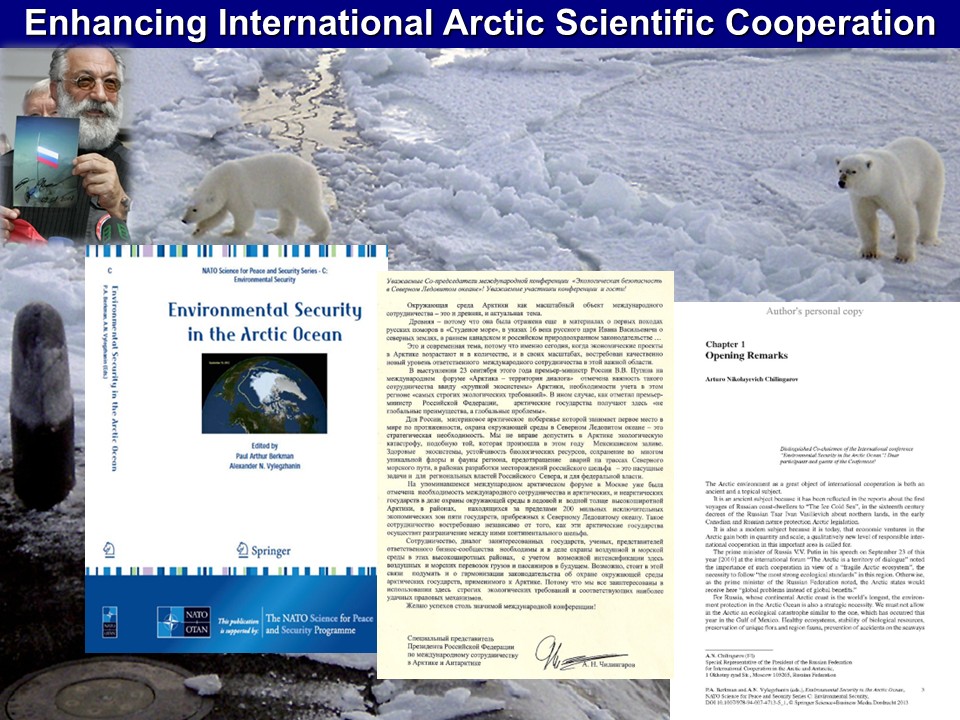
I co-directed and chaired the 2010 NATO Advanced Research Workshop at the University of Cambridge with Professor Alexander Vylegzhanin from MGIMO University, including the central contribution from Artur Chilingarov to consider Environmental Security in the Arctic Ocean. Artur and I met that year in Moscow and across the following decade in Arkhangelsk, Salekhard and St. Petersburg with the International Arctic Forums. It is an honour as well as pleasure to celebrate Artur’s larger-than-life contributions, remembering big bear hugs in each of our meetings as well as his inclusive observation in 2010 that: “The Arctic environment, as a great object of international cooperation, is both an ancient and a topical subjectâ€. Â
As neighbors with the longest maritime boundary of any two nations on Earth – north and south through the Bering Strait – Russia and the United States have been demonstrating their common interest to “Let the North Pole, be a pole of peaceâ€, as framed by Soviet President, Mikhail Gorbachev, in his famous 1987 speech, addressing “burning security issues†to end the Cold War with creation of an “Arctic Research Council†that became the Arctic Council in 1996 as a “high-level forum†for dialogue.
The warming Arctic with melting ice across marine and terrestrial systems along with the cascade of consequences – both biogeophysical and socioeconomic – has become a common interest across Arctic, near-Arctic and non-Arctic nations as well as residents, especially Indigenous Peoples.
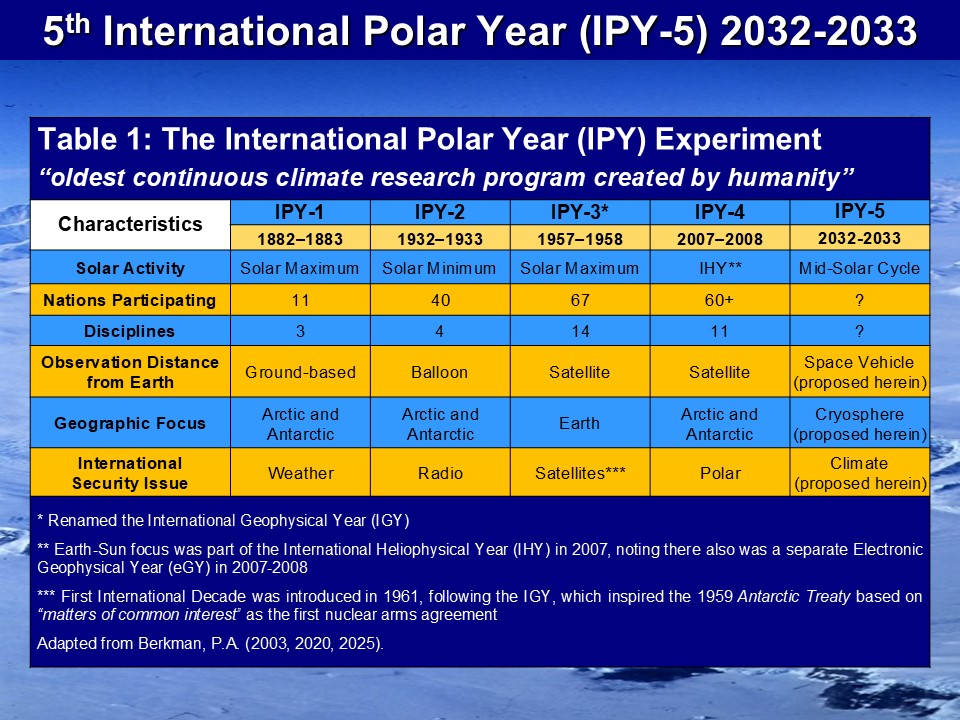
With the 5th International Polar Year (IPY-5) in 2032-2033, the international science community has a chance to balance national interests and common interests globally, as it did with the International Geophysical Year, which was renamed from the 3rd International Polar Year. Â
IPY-5 is an opportunity to enhance international Arctic scientific cooperation, as agreed among all of the Arctic states in 2017.
IPY-5 is far enough into the future to be imaginative and hopeful but close enough to be practical, especially to produce synergistic outcomes that inspire next-generation leaders across the Decade of Action for Cryospheric Sciences 2025-2034 and other Relevant International Decades, with research-into-action across the Earth’s cryosphere pole-to-pole. Â
- Approaching IPY-5, what are the questions of common concern to address with natural sciences, social sciences and Indigenous knowledge?
IPY-5 is the next step in the “oldest continuous climate research program created by humanity†– which began in 1882-1883 following the Little Ice Age in the North Atlantic region, continuing into the 20th century before-through-after the two world wars – demonstrating trust in science across generations with enduring capacities of the international science community.Â
Humanity is awakening to operate at century time scales.
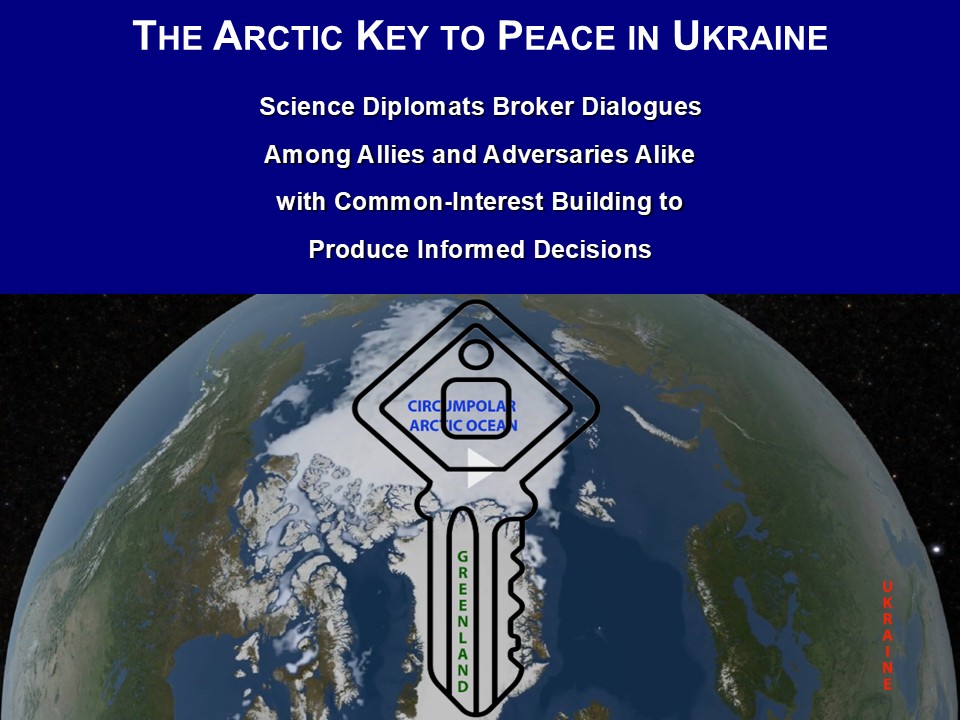
In the five Arctic Forums from 2010 to 2019, I heard President Vladimir Putin reiterate that Russia’s economic future is in the Arctic, telling me that it would be counter-productive for Russia to destabilize the Arctic. In a strange way, the economics of the Arctic seem its greatest stabilizing feature, respecting Russia’s geographic and historic presence in the Arctic.
For nations, peoples and our world – making informed decisions requires considerations across a ‘continuum of urgencies’ from security-to-sustainability time scales. A case study is with Ukraine and Russia and the peaceful solution that would be in the interests of all parties, including Europe, NATO and the United States short-to-long term.  Certainly, such a solution is only achievable if we think it.
Ukraine and the Arctic are connected, as revealed by the Arctic Council “pausing†in early March 2022, introducing connections potentially to reverse the polarity.
There would seem to be incentives for Russia, especially if the Arctic is her economic future. For the United States, there also seem to be strategic interests in the Arctic, which have been amplified with focus on Greenland during the second term of President Donald Trump, presumably in view of economics as well, requiring dialogue, especially with the Inuit residents. The meetings in Helsinki and Anchorage with Presidents Trump and Putin were on the doorsteps of the Arctic, introducing their “common heritage†as mentioned in Anchorage on 15 August 2025. Â
The Arctic path for dialogue with science diplomacy to achieve lasting peace in Ukraine is an option (without advocacy), which can be used or ignored explicitly, noting complexities that can only be addressed with questions: who, what, when, where, why and how. Â
This path with science as a tool of diplomacy worked in Antarctica and Outer Space throughout the Cold War as well as to enter a new era of international cooperation afterward and can work again on our shared journey toward IPY-5, providing a guiding light for our globally-interconnected civilization to dialogue across the 21st century with the North Pole as a “pole of peaceâ€Â .
Wishing all happy holidays and a new year with peace on Earth!!
