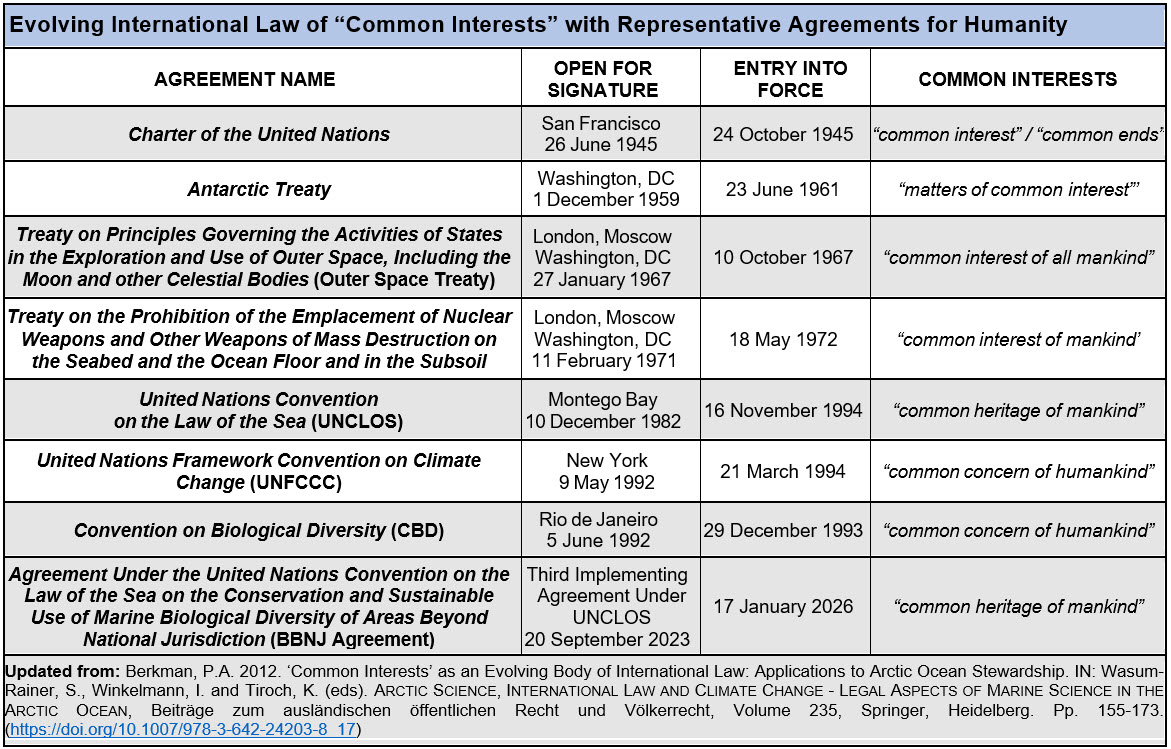
Today, 17 January 2026, the Agreement under the United Nations Convention on the Law of the Sea on the Conservation and Sustainable Use of Marine Biological Diversity of Areas beyond National Jurisdiction (BBNJ Agreement) enters into force, following 120 days after the 60th nations deposited its instrument of ratification. The BBNJ journey is a tribute to the brave leadership, inspiring collaboration and wisdom of Kristina Maria Gjerde (who passed away on 26 December 2025 at the age of 68), as reflected by many accolades with her legacy represented directly by the Ocean Stewardship Award launched by Synchronicity Earth.  This note is for my dear friend, missing her laughter, passion and curiosity that contributed to the benefit of all on Earth across generations.
“A” is for Area Beyond National Jurisdictions (ABNJ)
Following the Second World War, humanity began to identify international spaces beyond national boundaries and sovereign jurisdictions. The first such Area Beyond National Jurisdiction (ABNJ) emerged with the 1958 Convention on the High Seas with the  “high seas being open to all nations, no State may validly purport to subject any part of them to its sovereigntyâ€.Â
With momentum from the International Geophysical Year (IGY) 1957-1958 and inclusive global leadership from the United States during the administration of President Dwight D. Eisenhower – the next ABNJ emerged the following year with the 1959 Antarctic Treaty to ensure that “no acts or activities taking place while the present Treaty is in force shall constitute a basis for asserting, supporting or denying a claim to territorial sovereigntyâ€. The 1959 Antarctic Treaty also became the first nuclear arms agreement, which was a remarkable achievement with two superpower adversaries applying science diplomacy at the height of the Cold War.
With forever relevance, outer space became the next ABNJ with the 1967 Treaty on Principles Governing the Activities of States in the Exploration and Use of Outer Space, Including the Moon and other Celestial Bodies (Outer Space Treaty), establishing that “outer space, including the moon and other celestial bodies, is not subject to national appropriation by claim of sovereignty, by means of use or occupation, or by any other meansâ€. Aligning with its international legal precedents, the 1971 Treaty on the Prohibition of the Emplacement of Nuclear Weapons and Other Weapons of Mass Destruction on the Sea-bed and the Ocean Floor and in the Subsoil Thereof (Seabed Treaty) became the fourth ABNJ, all demonstrating that international spaces promote peace.
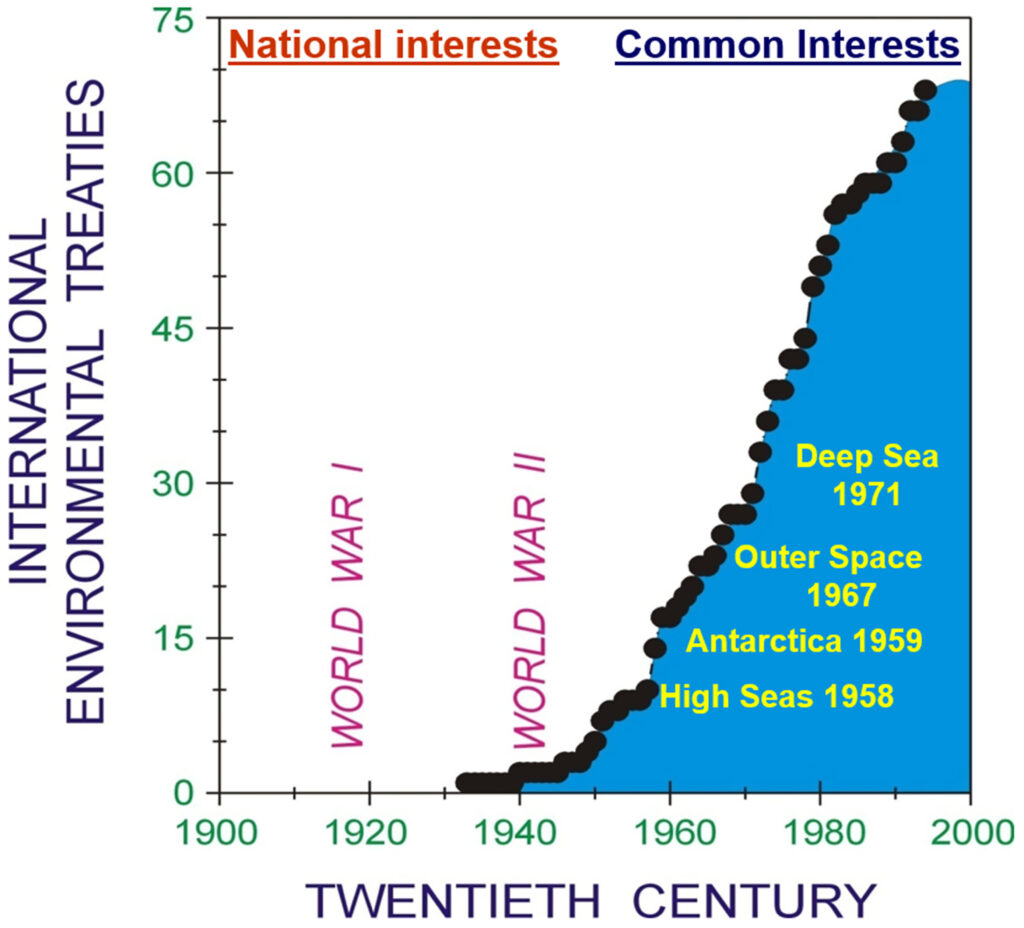
FIGURE 1: Areas Beyond National Jurisdiction (ABNJ) evolved after the Second World War, creating regions of common interest to help balance national interests on Earth. From Berkman, P.A. 2002. Science Into Policy: Global Lessons from Antarctica. Academic Press.
“B” is for Biodiversity Beyond National Jurisdiction (BBNJ)
The BBNJ Agreement that enters into force today builds on the ABNJ (Figure 1). Among the six “matters of common interest†with the 1959 Antarctic Treaty, the sixth involves “preservation and conservation of living resources in Antarcticaâ€, leading to the 1964 Agreed Measures on the Conservation of Antarctica Fauna and Flora, 1972 Convention on Antarctic Seals and eventually the 1980 Convention on the Conservation of Antarctic Marine Living Resources (CCAMLR). CCAMLR was a threshold with the ‘ecosystem approach’ involving “maintenance of the ecological relationships between harvested, dependent and related populations of Antarctic marine living resourcesâ€.
During this period, the Ambassador to Malta, Arvid Pardo, spoke to the United Nations General Assembly in 1967 about the “question of the reservation exclusively for peaceful purposes of the sea-bed and the ocean floor, and the subsoil thereof, underlying the high seas beyond the limits of present national jurisdiction, and the use of their resources in the interests of mankind”.  The legacy of that speech is the “common heritage of mankindâ€, at the heart of the 1982 United Nations Convention on the Law of the Sea (UNCLOS), but also as an enduring inspiration that global contributions originate with ideas rather than of the power of nations, considering the small island Mediterranean island of Malta achieved statehood only in 1964.
With momentum from the 1987 Report of the World Commission on Environment Development: Our Common Future about the three pillars of sustainable development – environmental protection, economic prosperity and societal well-being – United Nations Conference on Environment and Development was convened in Rio de Janeiro in 1992. The ‘Rio Earth Summit’  was a watershed with global strategies for humankind, empowering the 1992 United Nations Framework Convention on Climate Change (UNFCCC), 1992 Convention on Biological Diversity (CBD) and 1994 United Nations Convention to Combat Desertification (UNCCD).
To address biodiversity gaps beyond nations jurisdictions in UNCLOS and the CBD – the journey to produce the BBNJ Agreement began informally in 2004 with leadership from Kristina Gjerde among others, addressing “threats and risks to vulnerable and threatened marine ecosystems and biodiversity in areas beyond national jurisdictionâ€.   The eventual ratification steps with the BBNJ Agreement are shown in Figure 2, leading to the entry into force today (17 January 2025) of this binding international legal agreement.
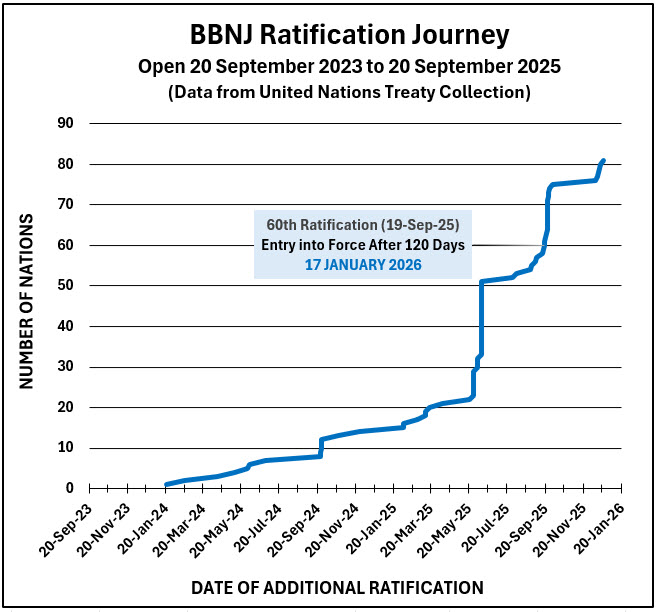
FIGURE 2: Ratification journey with the Biodiversity Beyond National Jurisdiction (BBNJ Agreement.
“C” is for Common Interests to Balance National Jurisdictions
The BBNJ Agreement that enters into force today comes at a moment when international law is being compromised, as demonstrated unambiguously by the 7 January 2026 Presidential Action about “Withdrawing the United States from International Organizations, Conventions, and Treaties that Are Contrary to the Interests of the United Statesâ€. This uninformed, self-interested and short-sighted decision (among many others) by The White House is in stark contrast to the wisdom and leadership of the United States that has maintained world peace since 1945.  Among the 60 international institutions included in The White House withdrawal is the International Union of Conservation of Nature (IUCN), which supported Kristina Gjerde.
Nationalism is unsustainable, as revealed during the first half of the 20th century (Figure 1). The challenge for humanity is to operate before-through-after the impending inflection point, building on the evolving international law of common interests (Table 1) and hope proclaimed today with the BBNJ Agreement to amplify the “common heritage of mankind” for the benefit of all on Earth across generations.