
Following is the first paragraph of an essay the Malaysian-American Commission on Educational Exchange (MACEE) invited me to “commemorate the 250th anniversary of the United States and the 80th anniversary of the Fulbright Program”. With symbolisms and synergies – this commemoration underscores a journey with science diplomacy that accelerated with the 1959 Antarctic Treaty on its 50th anniversary “with the interests of science and the progress of all mankind” – involving the 2009 Antarctic Treaty Summit that I had the honour to chair, which generated the first book in this transdisciplinary field. These opportunities stemmed from my Fulbright Distinguished Scholarship at the University of Cambridge in 2006-2007.
Contributing as a Fulbright Specialist 2024-2027 with the United States Department of State in Malaysia was intertwined with my appointment as a Distinguished Visiting Professor with the International Institute of Science Diplomacy and Sustainability (IISDS) at UCSI University in Kuala Lumpur from July-September 2025. The Fulbright Specialist project on CAPACITY BUILDING FOR SCIENCE DIPLOMACY involved: scholarly presentations at national and international meetings; diverse training, teaching and storytelling activities; high-level discussions with national leaders; and fabulous visits across this beautiful country during my 42-day visit. My time in Malaysia also overlapped with the Malaysian chairship of the Association of Southeast Asian Nations (ASEAN) in 2025 and positioning of Malaysia to become an ASEAN Center of Excellence with Science Diplomacy, as reflected by the International Conference on Science Diplomacy for Regional Prosperity in ASEAN in early August 2025 hosted by IISDS with the Malaysian Industry-Government Group for High Technology (MIGHT).
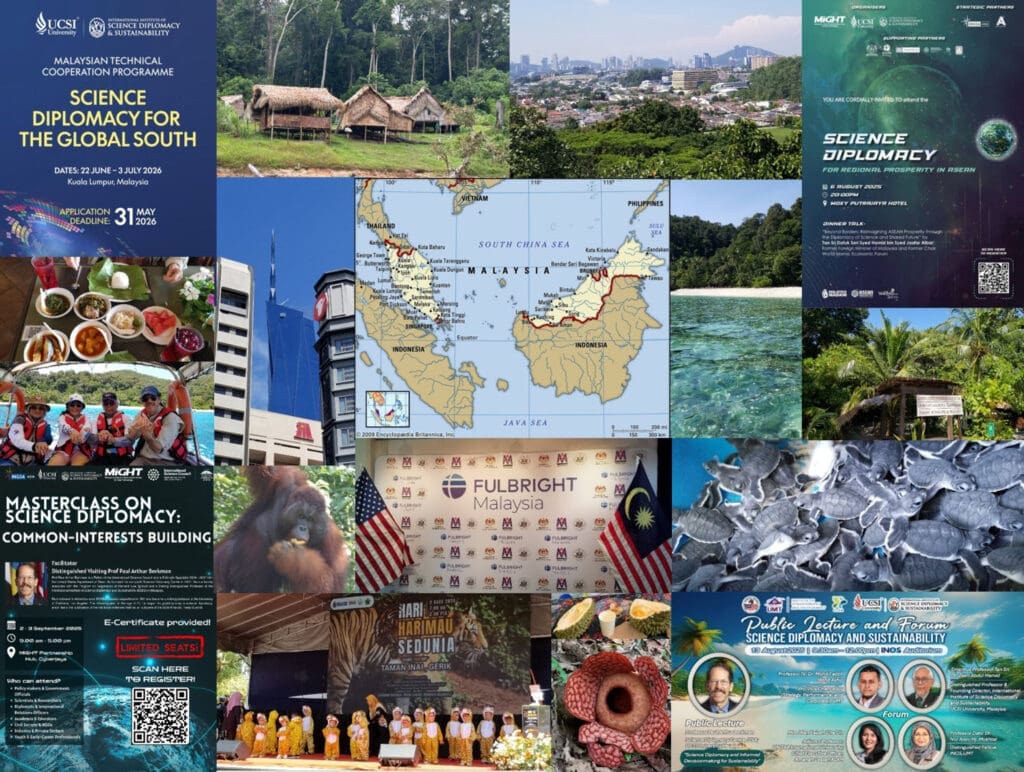
Collage of 42-day visit to Malaysia in Summer 2026 by Prof. Paul Arthur Berkman as a Fulbright Specialist 2024-2027 with the United States Department of State.
This commemoration also is crafted in view of the 80% reduction in the Fulbright Program budget that has been proposed for FY2027 by President Donald Trump, further signaling the perilous time we are living through when short-sighted national interests once again are dictating world affairs. With hope and inspiration – science diplomacy offers a scalable process to traverse the inflection point ahead with continuity before, during and after – empowered with informed decisionmaking across a ‘continuum of urgencies’.
OPERATING WITH SCIENCE DIPLOMACY
The 1959 Antarctic Treaty is the first nuclear arms agreement, emerging as a direct consequence of the International Geophysical Year (IGY) 1957-1958 – which was renamed from the 3rd International Polar Year (IPY-3) – when the first satellites were launched by design of the United States and Soviet Union, as stated in the 1955 National Security Council with the United States’ first space policy to “endeavor to launch a small scientific satellite under international auspices, such as the International Geophysical Year, in order to emphasize its peaceful purposes”.
- The IGY applied the dual use of rockets with science as a tool of diplomacy to address global security issues and motivate international resourcing for research on a planetary scale in the context of our Solar System, as a technological threshold in the 20th century with the International Polar Year (IPY) experiment that started with IPY-1 in 1882-1883;
- In view of current world affairs – the inclusive (who, what, when, where, why and how) lessons from the IGY are essential for humanity with science diplomacy and the 5th International Polar Year (IPY-5) 2032-2033 to inform decisions about our shared journey across the 21st century as a globally-interconnected civilization.
Science with the IGY and diplomacy with the Antarctic Treaty underlie the strategic foundations of science diplomacy based on “matters of common interest” to balance national interests in view of our shared survival “forever” after the Second World War.
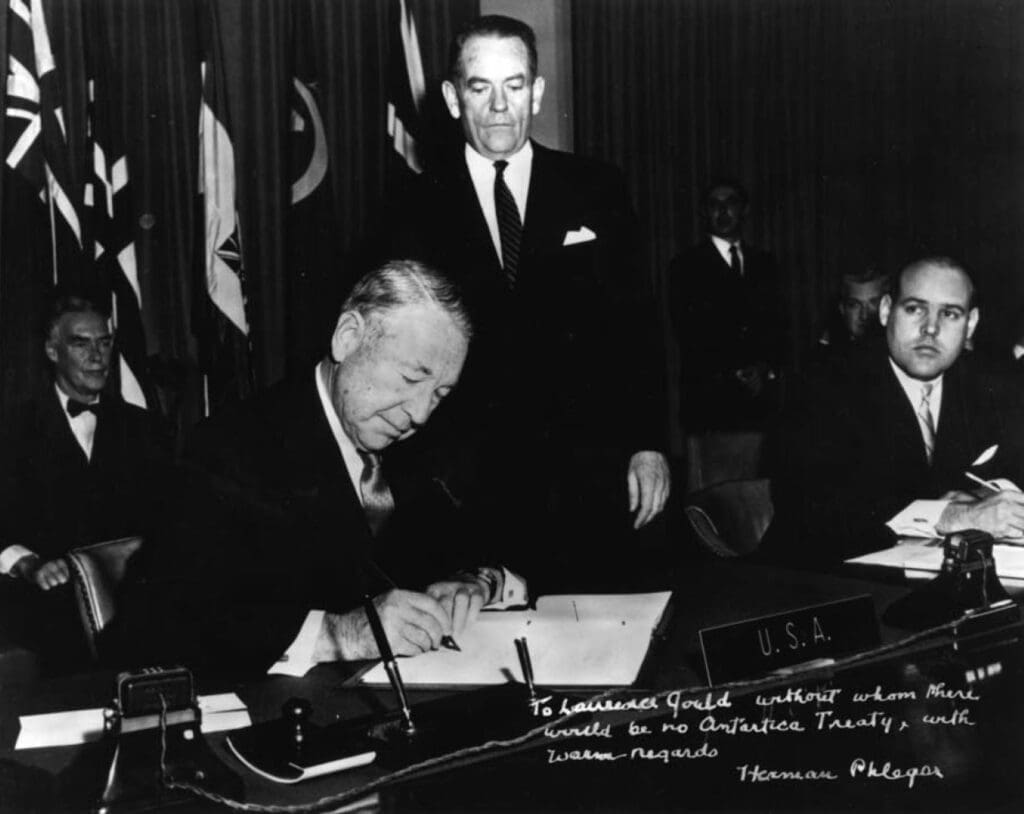
Antarctic Treaty signing in Washington, D.C. on 1 December 1959. From: President Eisenhower, the Antarctic Treaty, and the Origin of International Spaces (2011).
COMMEMORATING MALAYSIAN LEADERSHIP WITH GLOBAL INCLUSION
In view of this commemoration – the 2009 Antarctic Treaty Summit included Tan Sri Zakri Abdul Hamid from Malaysia among the International Steering Committee, which I had the honour to convene with due respect for the “Question of Antarctica” that was introduced by Malaysian Prime Minister, Dr. Mahathir Mohamad into the United Nations General Assembly in 1983. It was the ‘Question of Antarctica’, rather than the answer, that stimulated progress to expand the horizons of the Antarctic Treaty System with global inclusion (who, what, when, where, why and how).
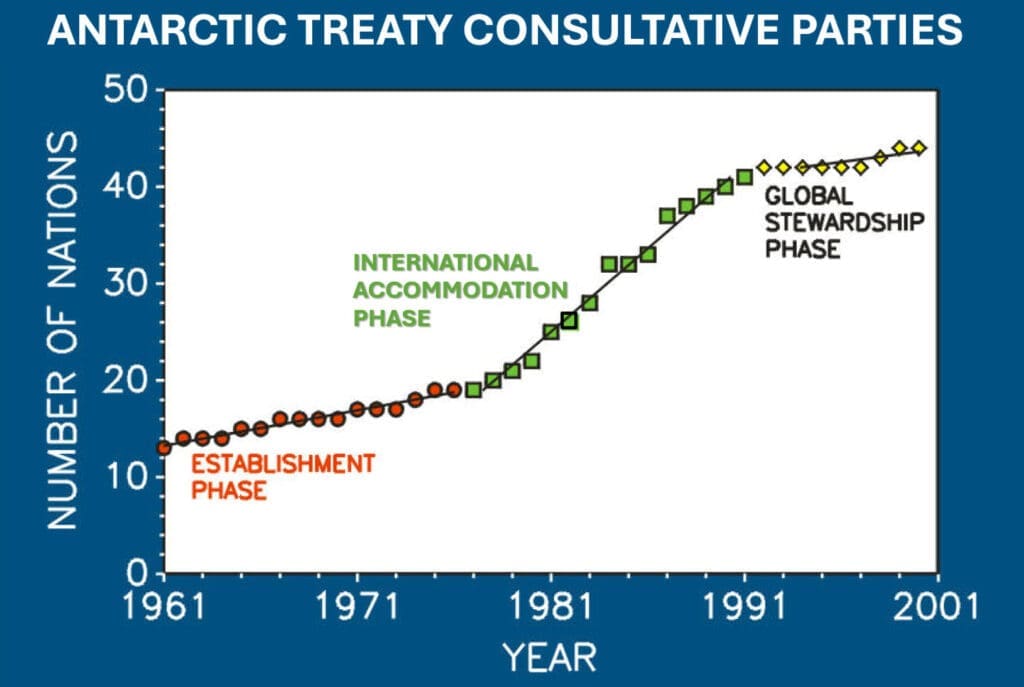
Antarctic Treaty System phases after the 1959 Antarctic Treaty entered into force on 23 June 1961, noting the number of signatory nations tripled in the 1980’s. From: Berkman, P.A. 2002. SCIENCE INTO POLICY: GLOBAL LESSON FROM ANTARCTICA. Academic Press, New York. 252 p.
The 2009 Antarctic Treaty Summit as a 4th International Polar year (IPY-4) project created a legacy both with the first book on Science Diplomacy and with ‘Antarctica Day’ on December 1st – which is the day the 1959 Antarctic Treaty was signed in Washington, D.C. with the United States and Soviet Union among ten other nations, including claimants and non-claimants – “in the interest of all mankind that Antarctica shall continue forever to be used exclusively for peaceful purposes”. 
- ‘Antarctica Day’ has since become an international day, celebrating a “day of freedom and of peace for all mankind”, as envisioned by President Dwight D. Eisenhower in his first inaugural address in 1953;
- With the 2012 founding of Yayasan Penyelidikan Antartika Sultan Mizan (YPASM), ‘Antarctica Day’ has been celebrated annually in Malaysia – as reflected by ‘Antarctica Day’ 2025 – onward with the legacy of international leadership emanating with the ‘Question of Antarctica’;
- Science diplomacy with IPY-5 in 2032-2033 – as the next step in the “oldest continuous climate research program created by humanity” – introduces synergistic opportunities with global inclusion to enhance Earth System Science as well as Open Science.
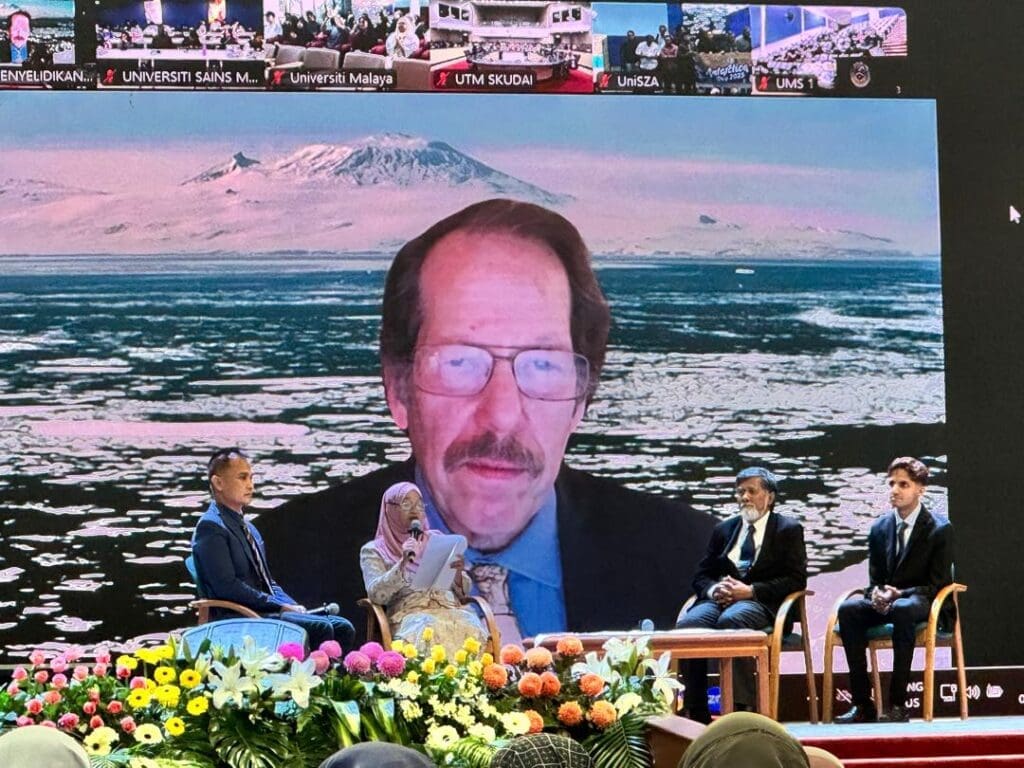
Hari Antartika in Malaysia 2025.
SCIENCE DIPLOMACY WITH THE GLOBAL SOUTH
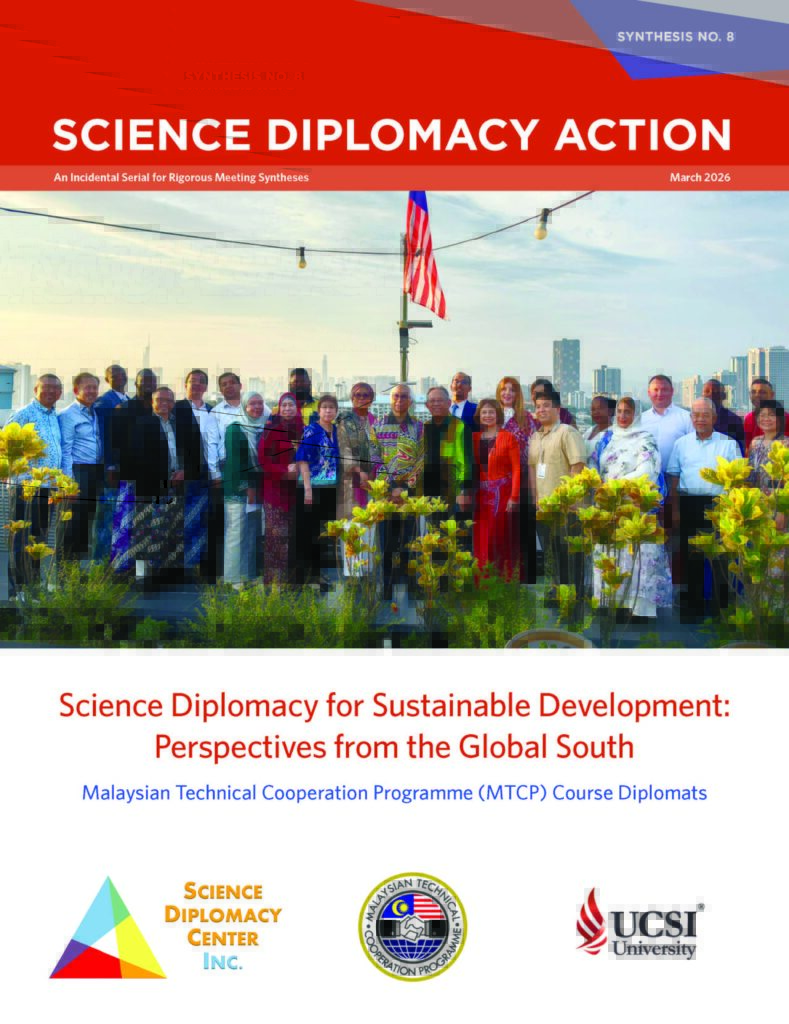
IISDS was launched at UCSI University to empower Science Diplomacy in the Global South. In addition to the potential ASEAN Center of Science Diplomacy mentioned above, IISDS leadership is reflected by the Science Diplomacy for the Global South course that began in 2025 with the Malaysian Technology Cooperation Programme (MTCP) under the Malaysian Ministry of Foreign Affairs. An outcome from the 2025 MTCP course is the inspirational sharing of perspectives with the participating diplomats from the thirteen Global South nations, together on the inclusive path of Our Common Future.
EMPOWERING GLOBAL DIALOGUE
The inspiration of the 1959 Antarctic Treaty is its articulation with “matters of common interest” as the foundation of a scalable methodology to make informed decisions that operate short-to-long term as opposed to uninformed decisions that only operate at a moment in time. Informed decisionmaking reveals common-interest building is a choice, in contrast to the default with international relations, involving conflict resolution as the only negotiation strategy.
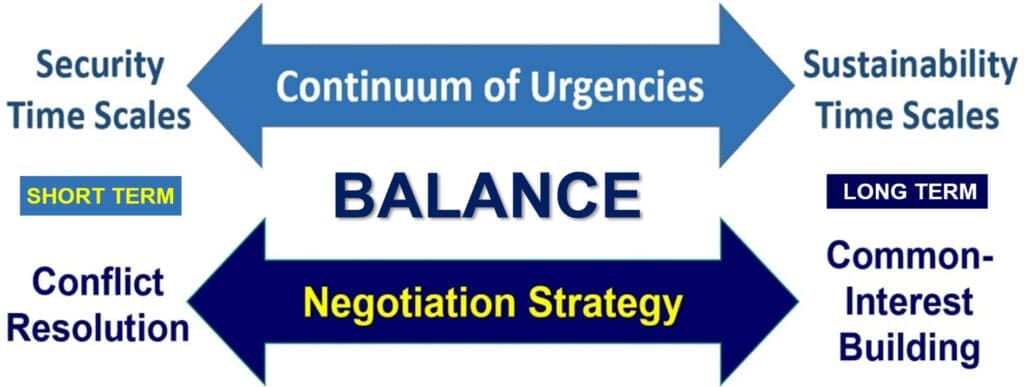
INFORMED DECISIONMAKING FOR SUSTAINABILITY (Springer book series).
The methodology of common-interest building was central to the Fulbright Specialist visit to Malaysia in 2025, which also overlapped with the third annual Global Indigenous Youth Summit on Climate Change (GIYSCC) that was initiated by the nonprofit Science Diplomacy Center, Inc. (SDCI) with the International Network for Governmental Science Advice (INGSA), involving IISDS from the start. GIYSCC is a “virtual dialogue by, for and among Indigenous youth with global inclusion” annually on August 9th – circling the Earth with the Sun across three 8-hour time zones in 24 hours (00:00-24:00 GMT) on the International Day of the World’s Indigenous Peoples.

- In its first three years, GIYSCC has engaged nearly 3000 registrants from 140 nations representing 355 languages – welcoming registration with GIYSCC-2026;
- With legacy considerations, in 2023, GIYSCC Indigenous Youth Leaders crafted an invited Nature Commentary that Indigenous Youth Must Be at the Forefront of Climate Diplomacy to initiate a Global Partnership of Indigenous Youth in the spirit of SDG 17 among the United Nations Sustainable Development Goals;
- Crafted by the GIYSCC Indigenous Youth Leaders after the first three years, the GIYSCC Strategic Plan 2026-2031 (draft) is being implemented with SDCI coordination.
Highlighting GIYSCC and its science diplomacy precedents – this commemoration represents a journey with global inclusion and common-interest building that continues to accelerate, despite short-sighted and self-interested dynamics that operate with exclusion in our world. As a proposition – informed decisionmaking is inevitable, most commonly as an outcome of uninformed decisions.
Climate is a “forever” issue on Earth that embodies informed decisionmaking, intersecting all stages of human existence, as United Nations Secretary-General Bank Ki-moon emphasized with the 2009 Antarctic Treaty Summit. With hope and inspiration, this commemoration of the Fulbright Program celebrates trust that emerges with science diplomacy and continuity in building common interests short to long term – “for the benefit of all on Earth across generations” – noting IISDS at UCSI University and SDCI both were founded in 2022 en route to their Memorandum of Understanding (MOU) that was signed in Kuala Lumpur on 4 September 2025.
